
Speed That Defies All Time
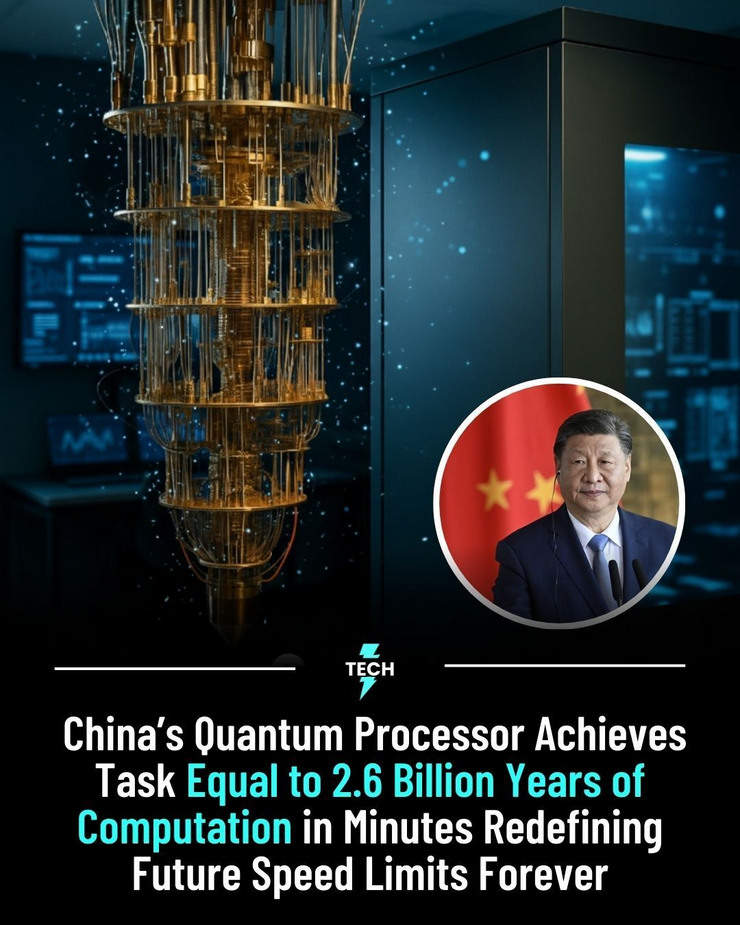
A groundbreaking leap in computational power has emerged from China, where researchers have unveiled a quantum computer capable of performing calculations that would take classical supercomputers 2.6 billion years — all completed in just minutes. This staggering achievement marks one of the greatest accelerations in processing speed ever recorded, pushing the limits of physics, mathematics, and technology into entirely new territory.
Scientists explain that the breakthrough comes from a new generation of qubits stabilized through ultra-precise error correction and entanglement algorithms. Unlike traditional computers that process information step by step, this quantum system explores countless possibilities simultaneously, allowing it to solve problems previously considered computationally unreachable. Early demonstrations show the machine completing vast simulations, ultra-complex optimization tasks, and cryptographic analysis in timeframes that redefine the meaning of “fast.”
What astonished researchers even more was the system’s stability, a challenge that has long limited quantum technology. By using advanced cooling systems, photon-based qubits, and AI-enhanced calibration, the machine maintained coherence long enough to execute workloads of unimaginable scale. Analysts say this positions China as a frontrunner in the global quantum race, with implications that stretch across cybersecurity, drug discovery, material science, climate modeling, and national defense.
This milestone not only breaks speed records; it signals a new era in which humanity’s computational boundaries may no longer be defined by classical limitations, but by the expanding frontiers of quantum reality itself.

